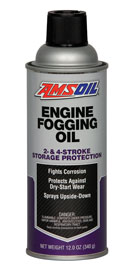
Engine Fogging Oil
Offers superior film retention, providing
long-term protection against corrosion and dry starts,
extending engine life and reducing operating expenses. Its
aerosol spray formulation offers easy and clean
applications, while reaching more components and offering
better distribution than straight motor oil.
See Pricing Information or Place an
Order
Package sizes include:
12-oz. Aerosol Can
12-oz. Aerosol Cans (case of 6)
Two- and four-stroke recreational vehicles, hand held power
equipment, small engines, construction and farm equipment are
commonly operated seasonally or infrequently, then stored for
long periods of time. During these periods of inactivity, and
as a result of fluctuations in ambient temperatures, water
vapor can form condensate within the engine. When this
condensate comes into direct contact with steel and iron
components, it forms surface corrosion on cylinder liners,
piston rings, anti-friction bearings and steel/iron contact
surfaces on rotational seals. Long periods of storage can also
dry out cylinders, often resulting in permanent damage when the
equipment is taken out of storage and dry started.
The severity of component distress resulting from extended
storage varies, but it is usually not enough to result in
immediate component failure. Often, equipment appears to
function properly when put back into service, failing shortly
thereafter as component distress increases with use. Because
the failure doesn’t happen immediately, the equipment owner
often does not suspect storage-related problems.
The industry is beginning to recognize the relationship
between storage-related corrosion and premature engine failures
and performance problems. Most two- and four-stroke motor oils
are formulated to have an affinity to engine component
surfaces, acting as a barrier that keeps condensate from
contacting engine components and forming corrosion. However,
the effectiveness of motor oil in this area diminishes with
time.
Two common methods are used to extend protection of stored
components. One method involves placing motor oil directly on
internal engine components, usually by pouring one or two
ounces of oil into the engine cylinders through the spark plug
holes and manually rotating the engine to distribute the oil.
The more effective, easier and cleaner method involves use of
an aerosol fogging oil. Because it can be applied through the
engine intake or carburetor as it is running, a fogging oil
reaches and protects more components than a straight motor oil.
In addition, the aerosol nature of fogging oil offers a more
complete distribution of the oil than the straight motor oil
method, something especially beneficial in applications with
horizontal cylinder orientation, such as outboard motors.
A survey of manufacturers in the affected market reveals all
have maintenance guidelines for long-term storage of equipment.
Forty-three percent indicated special maintenance is required
if length of anticipated equipment inactivity exceeds 30 days,
while 43 percent indicated a time period of 60 days and 14
percent indicated a time period of 90 days. All recommended the
application of additional oil to the engine for long-term
storage, and more than half suggested the use of a special
fogging oil.
New AMSOIL Engine Fogging Oil offers superior film
retention, providing long-term protection against corrosion and
dry starts, extending engine life and reducing operating
expenses. Its aerosol spray formulation offers easy and clean
applications, while reaching more components and offering
better distribution than straight motor oil.
AMSOIL Engine Fogging Oil applications include, but are not
limited to, motorcycles, snowmobiles, ATV’s, outboard motors,
stern drive and inboard marine engines, personal watercraft,
lawn equipment, chainsaws, snowblowers, portable generators,
hand held power equipment, motor scooters, powered farm
equipment, powered construction equipment, cars and trucks.
|